

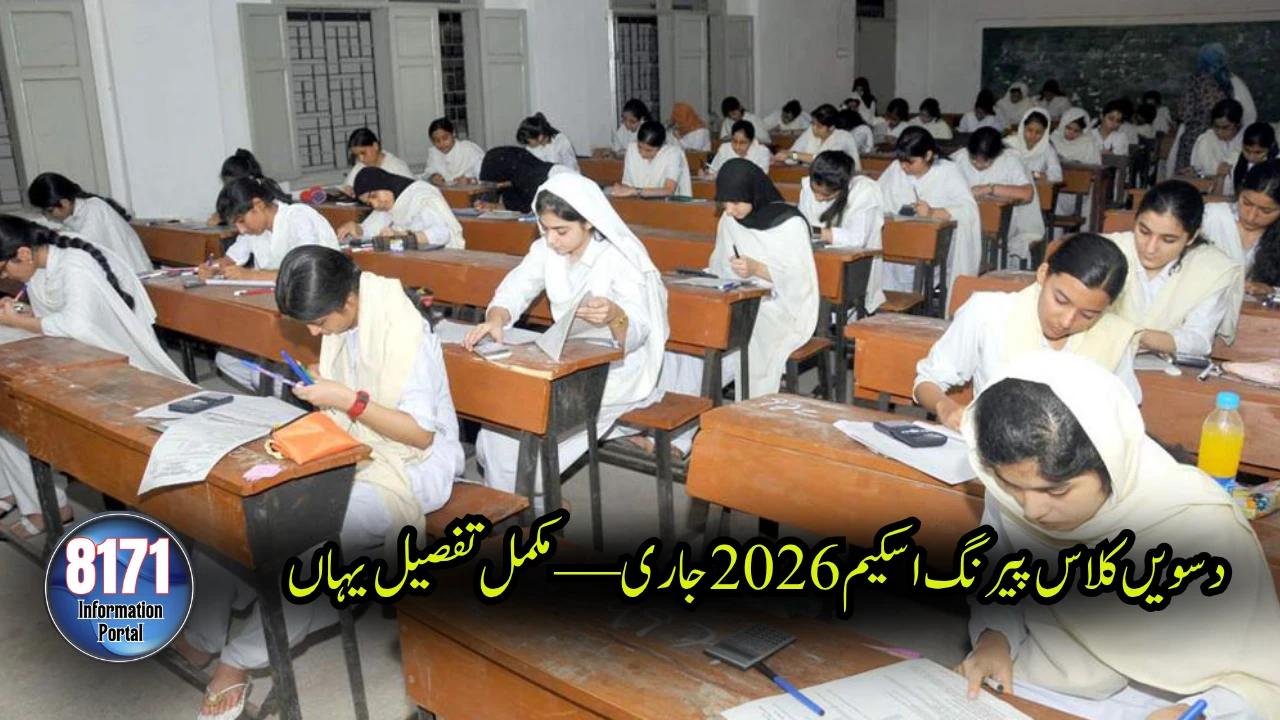
A pairing scheme is an official guideline released by education boards that explains how marks are distributed across different chapters of each subject.
It tells you:
-
Which chapters are paired together for long questions,
-
How many MCQs, short questions, and long questions will come from each chapter, and
-
How you can prepare smartly instead of studying blindly.
In short — the pairing scheme 2026 helps you study smart, focus on important chapters, and score better in board exams.
Also Read: 9th Class Pairing Scheme 2026
🗓️ For Which Boards Does It Apply?
The 10th Class Pairing Scheme 2026 applies to all Punjab Boards of Intermediate and Secondary Education (BISE), including:
-
Bahawalpur, Sahiwal, DG Khan, and Sargodha Boards
Although the format is similar across boards, minor variations may occur — so always check your official board website for confirmation.
📖 Subjects Included in the Pairing Scheme 2026
The updated 2026 pairing scheme covers both Science and Arts group subjects, such as:
🔬 Science Group
-
Physics – Chapter-wise pairing for numerical & conceptual questions
-
Chemistry – Balanced distribution of theory, MCQs, and equations
-
Biology – Diagram-based and short-answer emphasis
-
Mathematics – Paired chapters for theorems and word problems
-
Computer Science – Logical reasoning and practical-based MCQs
📚 Arts Group
-
General Science – Concept-based short questions
-
General Math – Simple to moderate level problem solving
-
English & Urdu – Grammar, essay writing, and comprehension weightage
-
Islamiyat & Pak Studies – Structured with MCQs and thematic questions
💡 Why the Pairing Scheme 2026 Is Important
-
🧭 Gives direction: You know exactly where to focus.
-
⏰ Saves time: You can plan chapter-wise revision efficiently.
-
🧠 Boosts confidence: Knowing the paper pattern reduces exam stress.
-
🎯 Improves results: Students who study according to pairing schemes perform 30–40% better in board exams.
📋 Tips to Use the Pairing Scheme Effectively
-
Make a study timetable according to chapter weightage.
-
Start with chapters that appear in long questions — they carry more marks.
-
Revise MCQs and definitions daily from paired chapters.
-
Practice past papers and model papers to understand the exact pattern.
-
Don’t rely only on the scheme — study the full syllabus for safety.
🧾 Download Official Pairing Scheme 2026 (PDF)
Students can download the complete subject-wise pairing schemes for all Punjab boards from the official BISE websites or verified education portals.


